

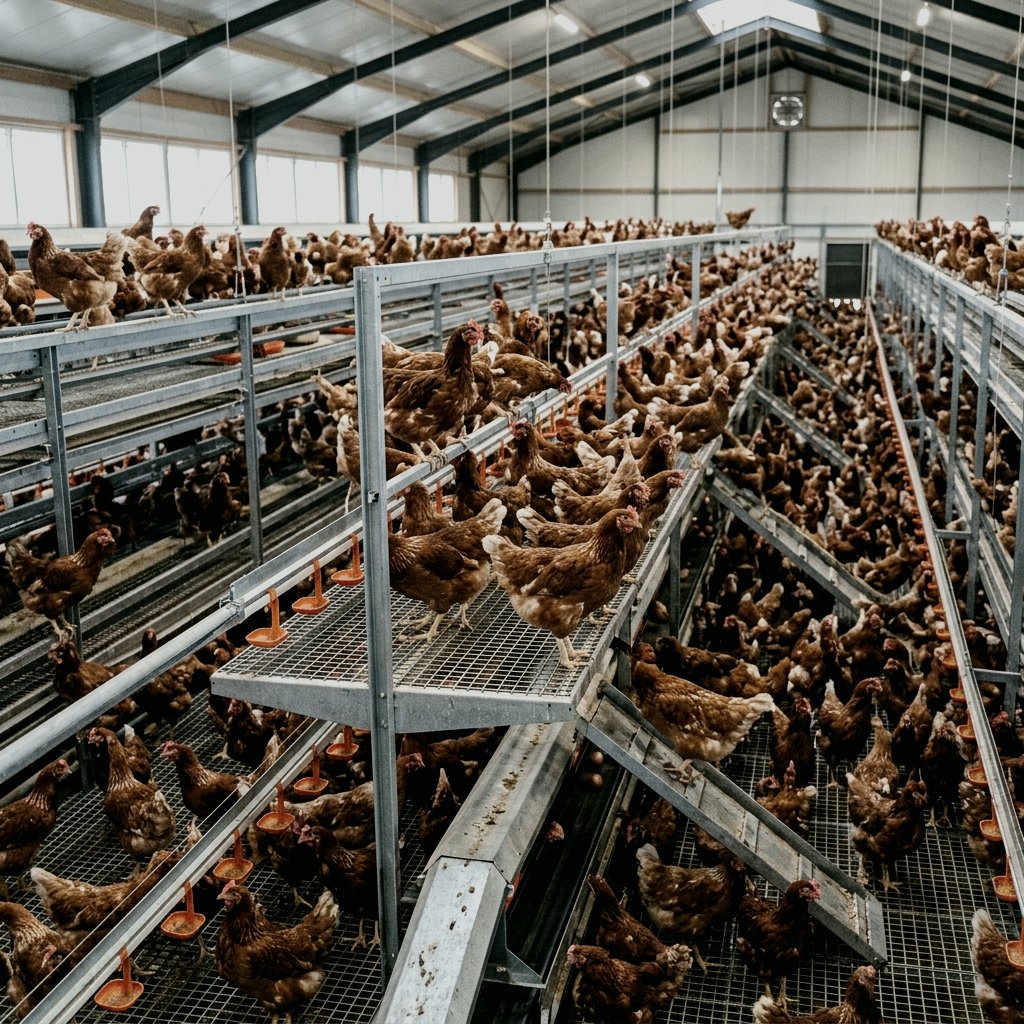
Seventy weeks is a long time to hold a curve.
A commercial layer is asked to produce an egg on most days for well over a year, on a ration that has to keep moving calcium into a shell the whole time. Persistency and seconds rate are what decide the value of the cycle — a downgraded egg is feed you have already paid for. EKOSHIELD Layer is a pellet-stable gut flora stabiliser intended to keep the intestinal community steady across that period.
HOW IT WORKS
A long cycle is a test of stability, not of peaks.
Most flocks reach peak. Fewer hold the back half of the curve, and that is where the cycle is won. Below are the established modes of action for the organism classes in EKOSHIELD. They describe how the product is intended to work; they are not performance guarantees.
Maintains microbial diversity
A varied community is a resilient one, and holds its shape better across the length of a laying cycle than a narrow one does.
Supports nutrient absorption
Villus height and crypt depth govern how much of the ration — minerals included — the hen actually recovers rather than excretes.
Produces antimicrobial metabolites
Bacteriocins and organic acids make the gut a less comfortable place for undesirable bacteria.
Short-chain fatty acid production
Fermentation end-products are the preferred fuel of the cells lining the gut, and feed the surface that does the absorbing.
Specification
What is in the sack.
Strain designations, inclusion rate and the batch Certificate of Analysis are issued with the technical dossier on request.
REQUEST THE TECHNICAL DOSSIER →Regulatory position
What we may and may not tell you.
This product is intended to:
- Stabilise gut flora
- Support zootechnical performance and feed conversion
- Support nutrient absorption
- Support eggshell quality and laying performance
- Promote a healthy microbiome
It is not:
A veterinary medicinal product. EKOSHIELD is a zootechnical feed additive in the gut flora stabiliser functional group. We make no claim that it treats or prevents any disease, reduces mortality, or replaces antibiotics for a therapeutic purpose — and we would ask you to be sceptical of any supplier who does.
The evidence behind the selection
Published layer results — obtained by other people.
Ekome is pre-launch and has run no commercial trials, so there is no EKOSHIELD figure on this page and there will not be one until we have earned it. What follows is peer-reviewed work in laying hens, carried out by independent groups using their own strains of the species we selected. It is the reason those species are in the product.
95.9% vs 94.3%
Hen-day egg production
Laying hens supplemented with B. subtilis (P = 0.048).
Chen et al. 2020, Poultry Science
2.08 vs 2.15
Feed per kg of egg
Reported alongside improved shell strength and thickness (P = 0.001).
Wang et al. 2021, Poultry Science
+7.84%
Laying rate at week 12
E. faecium supplementation in laying hens (P < 0.05).
Tang et al. 2026, Poultry Science
P < 0.05
Eggshell strength
Significant increase in shell breaking strength versus unsupplemented control.
Dong et al. 2025, Poultry Science
No published study tests the three organisms in EKOSHIELD together, and we say so before you ask. Where the evidence is thin we will tell you which organism it is thin for, and our technical team will help design a trial on your own units if you want a figure that belongs to your flock.
The economics
We are not going to put a number in this box.
You already know the three levers on a layer unit: eggs per hen housed, feed per dozen, and the proportion of what you produce that leaves the site as a second. You also know what a point of each is worth on your own site, which is more than any supplier does.
So run the arithmetic on your own figures. Take your seconds rate, your price differential between first quality and downgrade, and your feed cost per dozen. That tells you what any given movement is worth. What it will not tell you is what EKOSHIELD does — because we have no commercial cycle behind us, and we will not manufacture one.
Ask us for the papers and the dossier. Judge the reading, then design a trial with us.
Before lay
The cheap place to intervene is rear.
A pullet arriving at point of lay with a settled gut community is a better proposition than one you are trying to correct in production. EKOSTART is a six-organism lactic acid bacteria consortium for the rearing period, added to dry mixes. Used together, the two products cover the bird from placement to depletion.
EKOSTART LAYER FEED →