


Wellbeing, engineered at the gut wall.
A bird is comfortable when its gut is working. Everything EKOME makes is aimed at that one place, and this is what it achieves there.
WHAT THE PRODUCTS DO
Six things we build into every stage.
These are the zootechnical outcomes our products are formulated to deliver, in the functional group they belong to: gut flora stabilisers under Regulation (EC) 1831/2003.
FEED CONVERSION
Improves feed conversion
A well-colonised gut absorbs more of what the ration was formulated to deliver. The published species-level direction of effect is consistent: better conversion, and heavier birds at the same age.
GUT BALANCE
Stabilises gut flora
Our organisms establish and hold a defined microbial community, which is the functional group these products sit in. A stable community is a predictable one, through ration changes and through the warm weeks.
ABSORPTION
Supports nutrient absorption
Villus height, crypt depth and tight-junction integrity are the architecture of absorption. Across the selected species the published work shows that architecture developing favourably.
RESILIENCE
Builds a more resilient bird
Placement, grading, transport, stocking density and heat all ask something of a bird. A bird carrying an established gut community takes those days in its stride and keeps eating.
LAYING
Supports laying performance and shell quality
In layers the same gut stability shows up as hen-day production held higher for longer, better feed per kilo of egg, and measurable gains in shell strength and thickness.
DELIVERY
Arrives intact, by feed or by water
Ekoshield is spore-forming and comes through standard commercial conditioning at over 95% survival. The Sol presentations dissolve into the drinking line, which reaches every bird that drinks.
THE MECHANISM
Five steps, in order, through the life of the bird.
Arrive first
A chick hatches with a near-sterile gut that fills with whatever reaches it first. Feeding a defined community at placement decides what occupies that space.
Hold the ground
An established community occupies the gut wall and the nutrients around it, promoting conditions that favour the organisms you want to be there.
Acidify
Our lactic acid bacteria produce lactic acid and bring gut pH down quickly, which supports enzyme activity and digestion from the first feed onwards.
Build the surface
A settled community is associated with taller villi, deeper absorptive surface and tighter junctions between cells — more gut wall doing more work.
Stay through the stages
Starter, grower and finisher presentations keep the same community in place as the ration changes underneath it, so the bird has continuity across its whole life.
THE EVIDENCE LAYER
We did the research before we built the products.
Our organisms earned their place in a formal systematic review. We screened more than 300 on-target independent reports, read 189 of them in full, and found 32 published trials in which our species were put through a full trial in commercial birds by an independent research group. That is the confidence base our formulations stand on.
189
Full texts reviewed
32
Trials proving our species
The published results that decided our formulations.
Each figure below is a peer-reviewed, species-level result produced by an independent research group working with its own strains, and is attributed to its paper. Together they are the reason these organisms are in these products.
1.71 → 1.55
Broiler FCR
Day-42 body weight +7.6% (2,176 vs 2,023 g, P = 0.003). B. subtilis.
Chen et al. 2025, Poultry Science
1.72 vs 1.81
Broiler FCR, 0–6 weeks
B. licheniformis, administered in the drinking line (P < 0.05).
Liu et al. 2012, AJAS
95.9% vs 94.3%
Hen-day egg production
Laying hens supplemented with B. subtilis (P = 0.048).
Chen et al. 2020, Poultry Science
2.08 vs 2.15
Feed per kg of egg
Alongside improved shell strength and thickness (P = 0.001).
Wang et al. 2021, Poultry Science
1.97 vs 2.01
Layer FCR
P. acidilactici. Egg weight 62.9 vs 62.1 g (P = 0.015).
Mikulski et al. 2020, Poultry Science
18 trials
B. subtilis, clean single-species
In-feed trials with isolable effect in broilers and layers, plus a meta-analysis.
EKOME systematic review, 2026
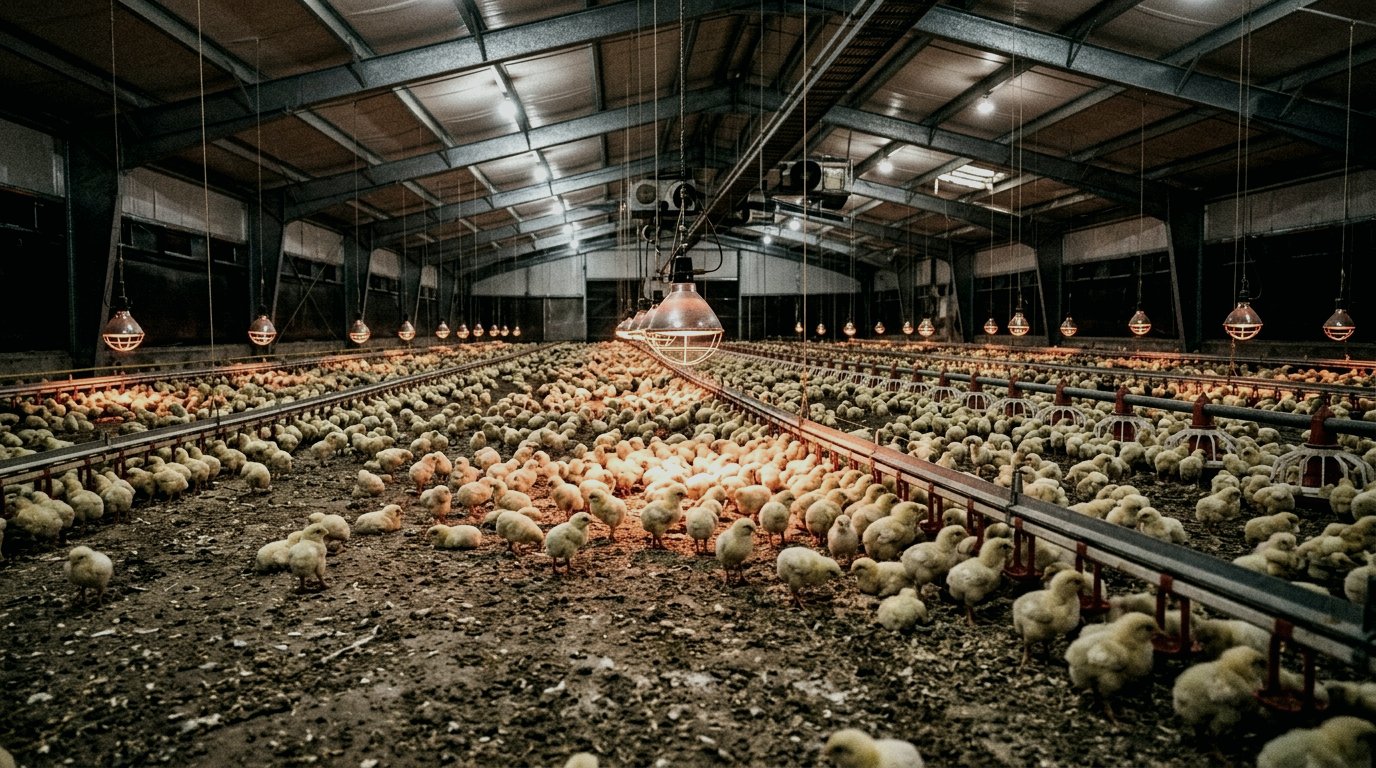
IN BROILERS
The deepest evidence base in the portfolio.
Broilers are where the published literature is strongest and most consistent. Our review isolated 18 clean single-species in-feed broiler and layer trials for B. subtilis alone, supported by a published meta-analysis, and four for B. licheniformis.
The direction of effect runs the same way across them: feed conversion improves and birds reach a heavier weight at the same age. In the strongest single trial, FCR moved from 1.71 to 1.55 and day-42 body weight rose 7.6% to 2,176 g (P = 0.003).
Gut morphology moves with it — taller villi, better villus-to-crypt ratios and firmer tight junctions, which is the physical reason a bird extracts more from the same ration.
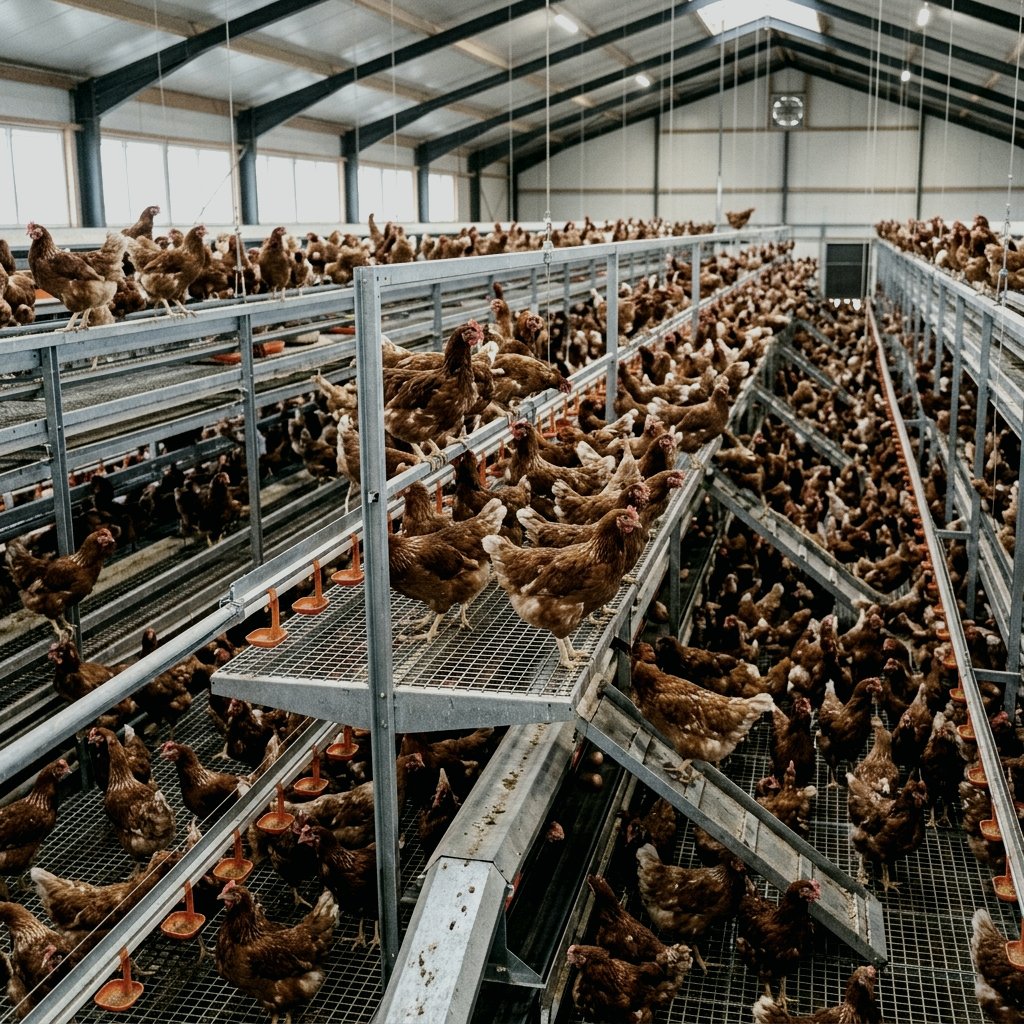
IN LAYERS
Output held higher, and a stronger shell.
In laying hens the same gut stability reports as persistency of lay. Hen-day production ran at 95.9% against 94.3% in a B. subtilis layer trial (P = 0.048), and feed per kilo of egg came in at 2.08 against 2.15 (P = 0.001).
Shell quality moves alongside it. The same work reported improved shell strength and thickness, and a P. acidilactici trial recorded FCR at 1.97 against 2.01 (P = 0.010) with egg weight up from 62.1 g to 62.9 g (P = 0.015).
For a layer unit, those are the three numbers that matter most over a long cycle: how many eggs, how much feed per egg, and how many of them grade first quality.
NEXT
See the range, and put a number on it.
Two products, twelve SKUs, three life stages, in feed and in the drinking line. The savings calculator sits on the same page, and runs on your own figures.